
Have you ever watched your child go from perfectly happy to completely falling apart in what feels like seconds? One moment they’re fine, and the next they’re on the floor, screaming, unable to hear a word you’re saying. You try to talk them down, but it’s like nobody’s home.
Or maybe you’ve noticed that once things escalate, logic goes straight out the window. You try to reason with them, offer solutions, explain consequences. And it makes absolutely no difference.
If this sounds familiar, there is actually a really good reason for it. And once you understand what is happening inside your child’s brain in those moments, everything starts to make a lot more sense.
A Simple Way to Understand Your Child’s Brain
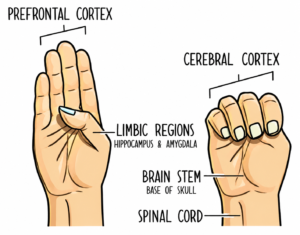
Neuroscientist Dr. Daniel Siegel came up with a brilliant tool called the Hand Model of the Brain. It uses your hand, yes, your actual hand, to explain how the brain works during big emotional moments.
Here’s how it works. Hold your hand up with your fingers pointing toward the ceiling.
Your wrist represents the spinal cord. Your palm represents the deepest, most primitive part of the brain, the part that keeps your heart beating and your lungs breathing. Fold your thumb across your palm, and that represents your limbic system, the emotional centre of the brain. Now fold your four fingers down over your thumb, and those fingers represent the thinking part of your brain, the prefrontal cortex.
That’s it. That’s your brain in your hand.
The Downstairs Brain and the Upstairs Brain
Think of the brain in two parts.
The Downstairs Brain (your palm and thumb) is the emotional, instinctual part. It handles survival. It detects danger, stores emotional memories, and controls your fight, flight, or freeze response. When your child feels scared, threatened, or overwhelmed, this is the part of the brain that takes charge.
The Upstairs Brain (your four fingers) is the thinking, reasoning part. This is where problem-solving lives. Where empathy, decision-making, and emotional control happen. The catch? This part of the brain does not fully develop until around age 25 to 30. Which means children are working with a very much “under construction” thinking brain every single day.
So What Does “Flipping the Lid” Actually Mean?
Now here’s where it gets really interesting, and really helpful.
When your child feels overwhelmed, stressed, or scared, their body releases a stress hormone called cortisol. This is the brain’s alarm system switching on. In an ideal world, the Upstairs Brain steps in and says, “It’s okay, we’ve got this.” But when the stress is too big, or the brain is still developing, that connection breaks down.
Lift your four fingers back up. That’s what happens. The Upstairs Brain flips open, and the Downstairs Brain takes over completely.
That is “flipping the lid.”
And when the lid is flipped, your child genuinely cannot access their thinking brain. They cannot reason. They cannot problem-solve. They cannot hear your very logical explanation of why hitting their brother is not okay. The connection between those two parts of the brain has temporarily gone offline.
This is not defiance. This is not manipulation. This is biology.
What This Looks Like at Home and at School
Flipping the lid can look different in every child. You might see:
- Full meltdowns with crying, screaming, or throwing things
- Complete shutdown, where your child goes silent and withdraws
- Physical responses like hitting, biting, or running away
- An inability to speak or respond to questions
- Saying things they don’t mean, like “I hate you” or “You’re the worst”
It can also happen in response to things that seem small to us, a sock that feels wrong, losing a game, being told no, an unexpected change in plans. But remember, the size of the trigger does not tell you how big the stress feels inside your child’s nervous system.
What Actually Helps in the Moment
Here is the most important thing to know: you cannot reason with a flipped lid. Trying to talk your child through logic while they are in full survival mode is like trying to have a conversation during a fire alarm. Their brain simply cannot hear you right now.
Here is what to do instead:
Stay calm yourself. Your nervous system can actually help regulate theirs. When you stay grounded and regulated, you become a safe anchor for your child to return to. This is not always easy, and that is completely understandable, but even taking a slow breath yourself can help shift the energy in the room.
Acknowledge what they’re feeling. You don’t need to fix it or explain it. Simply naming the emotion out loud, “You’re really frustrated right now, I can see that,” can help your child feel seen, which is often what the brain needs to start coming back online.
Give them space. Pressing in with questions or instructions during a meltdown often escalates things further. Sometimes the most powerful thing you can do is simply be nearby, calm, and patient, without demanding anything from them.
Keep your words simple. If you do need to communicate, less is more. Short phrases like “I’m here” or “You’re safe” are far more effective than long explanations. You can also try a “first, then” statement: “First calm down, then we’ll talk.”
Offer sensory support. Some children regulate more quickly when they have access to something physical. A weighted blanket, a tight hug if they want it, a cold drink, a fidget tool, or even going outside can help the nervous system settle more quickly.
Wait until the lid is back on. Once your child is calm and their thinking brain is back online, that is the time to reflect, problem-solve, or talk about what happened. Not before. Trying to have the conversation too early will just flip the lid again.
This Is a Skill, Not a Character Flaw
Flipping the lid is something that happens to all of us, adults included. We have all said something we regret in a moment of anger, or frozen up when we felt overwhelmed. The difference is that adults have had decades to build the brain connections that help us recover more quickly.
Your child is still building those connections. Every time you stay calm alongside them, every time you help them name their feelings, and every time you give them space to come back to themselves, you are literally helping their brain grow.
That is not a small thing. That is everything.
You Do Not Have to Figure This Out Alone
Understanding your child’s brain is one piece of the puzzle. But knowing what to do in the heat of the moment, for your specific child, in your specific family, is where having the right support makes all the difference.
An occupational therapist can help you understand what is driving your child’s emotional responses, identify the sensory or environmental triggers that are flipping their lid, and build a practical toolkit that works for your family’s real life. If you are based in Adelaide and would like that kind of personalised support, we would love to help.
Because every child deserves to feel understood. And every parent deserves to feel equipped.