
At Learn for Life, we believe that understanding why a skill is difficult is just as important as working on the skill itself. One of the frameworks that guides our thinking is the Pyramid of Learning.
The Pyramid of Learning helps us understand how skills build on one another, and why some children find certain tasks unexpectedly difficult. Rather than looking only at the surface challenge, it encourages us to consider what might be happening at a deeper level, and whether foundational skills could be playing a role. It’s one of several lenses we use to make sure we’re seeing the whole picture of your child’s development.
So What Is the Pyramid of Learning?
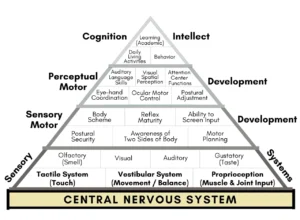
Think of your child’s development like a pyramid. The skills we tend to focus on, things like reading, writing, and problem-solving, sit at the very top. But those skills can only develop well when the layers underneath are solid.
At the base of the pyramid are the foundational skills: sensory processing, balance, body awareness, and movement. These aren’t glamorous or obvious, but they are everything. Just like a building needs strong footings before the walls can go up, your child’s brain and body need these foundations in place before the higher-level skills can develop smoothly.
What Happens When the Foundation Is Still Developing?
When the base of the pyramid needs strengthening, it doesn’t mean something is “wrong” with your child. It simply means some of the building blocks are still being laid.
You might notice your child:
- Wriggling constantly in their seat or struggling to sit comfortably
- Using too much or too little pressure when writing or drawing
- Avoiding certain textures, foods, or physical activities
- Getting overwhelmed in busy or noisy environments
- Finding it hard to focus, even when they genuinely want to
- Seeming clumsy or bumping into things more than other kids
These are not behaviour problems. They are signals from your child’s nervous system that some foundational skills need more support.
Why Play Is More Powerful Than It Looks
Here’s something worth knowing: children build these foundational skills almost entirely through movement and play.
Climbing, swinging, jumping, digging, building, and rolling are not just fun. They are how the brain and body develop balance, coordination, body awareness, and sensory processing. Every time your child scrambles up a play structure or spins on a swing, they are literally laying down the neural pathways that will later support sitting at a desk, holding a pencil, and concentrating in class.
This is why we never underestimate the power of good, messy, active play.
How Occupational Therapy Uses This Framework
As paediatric OTs, we use the Pyramid of Learning to look beyond the surface. When a child is struggling with handwriting or attention, we ask: what’s happening at the foundation level that might be making this harder?
Here’s what support can look like in practice:
Finding the missing pieces: We assess which foundational skills might be affecting your child’s participation at school, at home, and in everyday life. This gives us a clear, individualised picture of where to focus.
Building through play: Therapy activities are designed to be genuinely enjoyable. Obstacle courses, sensory play, movement games, and balance challenges are all purposeful ways to strengthen the foundations your child needs.
Strategies for home and school: We share simple, practical tools that you and your child’s teachers can use every day. This might include movement breaks, sensory supports, or small changes to your child’s environment that make a big difference.
Working as a team: We collaborate with you, your child’s school, and any other professionals involved, because consistent support across different environments is where the real progress happens.
A Different Way to See Your Child’s Challenges
It can be easy to interpret your child’s difficulties as laziness, defiance, or lack of motivation. But when you understand the Pyramid of Learning, a different picture emerges.
Your child isn’t choosing to struggle. Their brain and body are doing their best with the foundations they have right now. That’s not a limitation. It’s a starting point.
Strong Foundations Change Everything
When foundational skills are supported, children often surprise everyone around them. Tasks that felt impossible become manageable. Learning that felt out of reach starts to click. Your child feels calmer, more capable, and more confident in who they are.
If you’re based in Adelaide and you’ve been wondering whether occupational therapy could help your child, we would love to chat. Every child’s pyramid looks a little different, and that’s exactly why we take the time to understand yours.