
Watching your child fall apart over a lost game, a mistake, or a change in plans can be really hard. You want to help, but sometimes nothing you say seems to land. And if it happens often enough, you might start wondering whether something deeper is going on, or whether you’re somehow making it worse.
You’re not. And your child isn’t broken. They’re simply still learning one of the hardest skills there is: how to cope when things don’t go their way.
The good news is that resilience isn’t something children either have or don’t have. It’s a skill, and like all skills, it can be built over time with the right support.
Why Do Some Children Struggle to Bounce Back?
Before we talk about strategies, it helps to understand what’s actually happening when a child falls apart over disappointment.
For many children, especially those who are sensitive, perfectionistic, or still developing their emotional regulation skills, setbacks don’t just feel frustrating. They can feel catastrophic. Their nervous system responds as though something has gone genuinely wrong, and from the inside, it has.
This isn’t a behaviour problem. It’s a sign that your child needs support building some specific skills around flexibility, self-talk, and emotional regulation.
Practical Strategies to Build Resilience at Home
1. Encourage Helpful Self-Talk
Children often internalise mistakes as evidence that they are not good enough. One of the most powerful things you can do is help them develop a different inner voice.
Try modelling and encouraging phrases like:
- “I can’t do it yet, but I’m learning.”
- “We all make mistakes. That’s how we get better.”
- “I gave it my best, and that matters.”
- “It’s okay to feel disappointed. This feeling will pass.”
Write a list of these statements together and put them somewhere visible, like the fridge or bedroom wall. Returning to them during calm moments makes them much more accessible when things get hard.
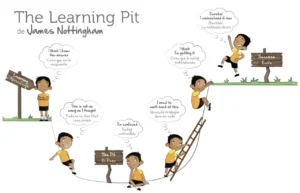
2. Use the Learning Pit
The Learning Pit is a simple visual concept that helps children understand that feeling stuck is a normal and necessary part of learning. When we try something new or challenging, we often “fall into the pit” before we find our way out.
Drawing this together and labelling each stage (starting out, feeling stuck, trying something new, getting there) gives children a map for their experience. It reframes struggle as progress rather than failure.
3. Try Plan A, B, C Thinking
Many children become so focused on one desired outcome that when it doesn’t happen, they have nowhere to go emotionally. Teaching flexible thinking helps with this.
Using a simple Plan A, B, C framework can make this concrete. For example, if the park is closed:
- Plan A: Go to the usual park (not available today)
- Plan B: Try a different park
- Plan C: Have a picnic at home
- Plan D: Build a cubby inside
Practising this kind of thinking during calm, low-stakes moments helps children access it more easily when they’re already feeling frustrated.
4. Use the CPS Model to Problem-Solve Together
Dr Ross Greene’s Collaborative and Proactive Solutions (CPS) model is a respectful, practical approach to working through challenges with your child. Rather than reacting after the fact, it invites your child into the problem-solving process.
It has three simple steps:
Empathy first: Start by understanding your child’s perspective. “I noticed you got really upset when the game didn’t go your way. What was going on for you?”
Name the problem: Share your concern without blame. “I want game time to feel fun and fair for everyone.”
Invite collaboration: Brainstorm together. “What do you think we could try next time?”
This approach helps your child feel heard and capable, which is exactly the foundation resilience is built on.
5. Practise Through Play
Games and playful challenges are one of the best low-pressure environments for practising frustration tolerance. Let your child play games where there’s a genuine chance of losing, and support them to reflect on the experience afterwards.
Focus on effort rather than outcome: “I loved how you kept trying even when it got hard” goes much further than praising the result. You can also set up gentle challenges at home like puzzles, obstacle courses, or building projects, and celebrate persistence over perfection.
6. Support Regulation Before Problem-Solving
Here’s something important: children cannot reflect, reason, or problem-solve when their nervous system is dysregulated. Before anything else, their body needs to feel safe and calm.
Some helpful co-regulation tools include:
- Breathing exercises like “smell the flower, blow out the candle”
- A sensory object such as a stress ball or soft toy
- A short walk, some jumping, or other movement
- Drawing or scribbling to release emotion
Consider making a calm-down kit together with your child, a small collection of items that help them feel grounded. Having it ready before a hard moment means it’s actually useful when one arrives.
7. Reflect and Celebrate Progress
After a difficult moment has passed and your child is calm, take some time to reflect together. Open-ended questions work well here:
- “What part was hardest for you?”
- “What helped you feel better?”
- “What might you try differently next time?”
- “What are you proud of?”
You might also consider a simple resilience tracker where your child can note or draw moments when they stayed calm, asked for help, or tried again after feeling discouraged. Seeing their own progress builds confidence over time.
Reframing What Resilience Actually Means
Resilience doesn’t mean your child never feels upset, frustrated, or disappointed. It means they are developing the capacity to feel those things, move through them, and come out the other side.
Every time your child tries again after failing, asks for help instead of shutting down, or finds a Plan B when Plan A falls apart, they are being resilient. Those moments are worth naming and celebrating, even the small ones.
When Extra Support Can Help
If your child regularly becomes overwhelmed by disappointment, struggles significantly with flexible thinking, or finds it hard to regulate their emotions in daily life, occupational therapy can help.
At Learn for Life, we work with children to build emotional regulation, flexible thinking, and the confidence to tackle challenges. If you’d like to find out more, we’d love to hear from you.