
For a young child, a page of lines can be a puzzle. Where does the letter start? How big should it be? Why does the p sink below the line while the a sits neatly on top? The rules that feel obvious to adults are genuinely hard to see when you are five and still making sense of how letters live on a page.
Sky, grass and dirt is a lovely, visual way to make those invisible rules easy to picture. It turns the writing space into a little landscape and gives children a clear, playful map for where each letter belongs and how big it should be.
The three zones
Imagine the writing lines as a slice of the outdoors, from top to bottom:
- Sky is the space up the top. Colour it blue. This is where tall letters reach.
- Grass is the middle space where the small letters sit, resting on the grass line. Colour it green.
- Dirt is the space below the grass line, underground. Colour it brown. This is where letters with tails dig down.
Once a child can see the landscape, letter placement stops being a set of abstract rules and becomes a story they can follow.
The three letter families
Letters fall into three friendly groups depending on how they use the space.
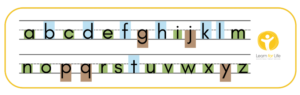
Sky letters are the tall ones. They start up in the sky and come down to sit on the grass: b, d, f, h, k, l, t, and all the capital letters.
Grass letters are the small ones. They live only in the grass, sitting on the line and filling the middle space: a, c, e, i, m, n, o, r, s, u, v, w, x, z.
Dirt letters are the ones with tails. Their bodies sit in the grass, and their tails dig down into the dirt: g, j, p, q, y.
A fun way to introduce this is to sort letters into the three families together, so the child starts to notice the patterns for themselves.
Why it works
Sizing and placement are two of the most common early handwriting hurdles, and this method makes them visible. By turning an abstract set of rules into a picture, it gives children something concrete to hold onto, in language they can feel in their body and easily remember. With a clear map to follow, letters are less likely to float above the line, sink below it, or come out all different sizes. Best of all, it keeps handwriting playful and low pressure, turning something that can feel serious into a little world to explore.
Bringing it to life
You do not need fancy materials. A few ideas to try at home or in the classroom:
- Colour the zones. Use blue, green and brown to shade the sky, grass and dirt on the page, or draw your own three-zone lines. Add a sun, some grass blades, and a worm or two in the dirt for fun.
- Start big and move the whole body. Before pencil and paper, draw giant letters in the air, on a whiteboard, or on the footpath with chalk. “Let’s make a tall l reaching all the way up to the sky.”
- Get sensory. Write in a tray of sand or shaving foam, where letters press in and hands really feel the movement. Many children learn placement more easily this way.
- Talk it through. Simple spoken cues while writing help a lot: “Start in the sky, come down to the grass,” or “That letter has a tail, so it digs into the dirt.”
- Sort the families. Pop letters into sky, grass and dirt groups together as a game.
- Fade the supports slowly. As placement becomes more natural, gradually use less colour and fewer reminders, until the child is holding the map in their own head.
Keep the desk visual below handy on the table or tucked into a workbook, so this little map is always within reach when your child picks up a pencil.
Keep it gentle and neuroaffirming
Sky, grass and dirt is one helpful tool, not a test. A few things worth keeping in mind:
- Follow your child’s pace. Some children take to the imagery straight away, others need more time or a different support, and both are completely fine.
- Handwriting sits on top of other skills. Comfortable posture, a stable shoulder and core, and hand strength all make letter formation easier. If writing is a real effort, it can help to build those foundations through play rather than pushing more practice.
- Celebrate the effort. Wonky letters are part of learning. Noticing that a child remembered to sit their letter on the grass matters more than a perfectly formed line.
- It is not about neatness alone. The goal is a child who feels capable and clear about where letters go, not a page that looks tidy under pressure.
Giving letters a home
When letters have a home, whether sky, grass or dirt, placing them stops feeling like guesswork. Children get a simple, playful map they can picture every time they pick up a pencil, and that clarity builds both skill and confidence.
Knowing where each letter belongs helps us write neatly, keep our letters the right size, and make our words easy to read. When you write, remember: sky letters reach up, grass letters stay in the middle, and dirt letters dig down.
About Learn for Life
Learn for Life is a neuroaffirming paediatric occupational therapy practice in Torrensville, Adelaide, supporting children, adolescents, and young adults to build everyday skills in ways that honour who they are. Sky, grass and dirt is one of many playful, practical strategies our occupational therapists use to support handwriting, including letter placement, sizing, pencil grip, and the underlying skills that make writing feel easier.
If handwriting is tricky for your child, our team can look at the whole picture, from posture and hand strength to letter formation, and build a plan that fits them.
Learn more about how occupational therapy can support your child at learnforlifeot.com.au.